How do serotonin levels change when it has to make friends elsewhere?
I can't sleep, so what else to do.
On Reddit, in one (non)specific subreddit, this question is asked relatively often.
Mostly in the context of people being afraid to start antidepressants precisely because of their difficult beginnings and fearing that it will be permanent - the fear of weight gain, fatigue, emotional blunting, etc.
All these feelings are completely justified. What is often overlooked, though, is the classic survivorship bias. These fears are based primarily on posts from users experiencing the most severe side effects. Those who actually find relief and don't go through a major hell simply live their lives and don't have the tendency to write essays about it on the internet.
But let's be brutally honest with ourselves - we all have completely different morphology and brain chemistry.
And since I have a psychology background, a sick obsession with complex systems, and I love building analytical spreadsheets, I forced myself to put together a visualization. Originally, it was supposed to be an overly simplified table, but then I realized the human body isn't an Excel cell and a pill doesn't teleport into the bloodstream. For it to have any real informational value, we had to go deeper.
SO.
Checklist of things I eventually needed:
- Figure out the elimination half-life of escitalopram and how liver enzymes throw a wrench into it.
- Ditch the naive exponential decay and understand the 1-compartment pharmacokinetic model (absorption vs. elimination).
- Calculate the volume of distribution and body weight to get to the real plasma concentration (ng/mL), not just imaginary "milligrams in the body."
- Include the active metabolite (S-DCT), because the drug doesn't just disappear from the body, it transforms.
- Convert the whole equation into Excel functions and apply dynamic dosing.
- Create a functional dataset and charts.
1. Escitalopram elimination half-life and treacherous liver
Escitalopram has a biological half-life of roughly 30 hours on average after repeated dosing.
The biological elimination half-life is the time required for the concentration of a drug in the plasma to decrease to half of its initial value.
But here is where reality steps in. Those 30 hours apply if you have an averagely functioning CYP2C19 liver enzyme. If you are a "rapid metabolizer," your body might clear the drug in just 27 hours. If you are "slow," it can take up to 50 hours.
Absorption to reach maximum concentration (Tmax) takes roughly 4 hours. Originally, I didn't want to account for it, but this gradual, 4-hour filling of the blood is exactly why the pill doesn't launch you into outer space right after swallowing it.
2. The formula for biological reality
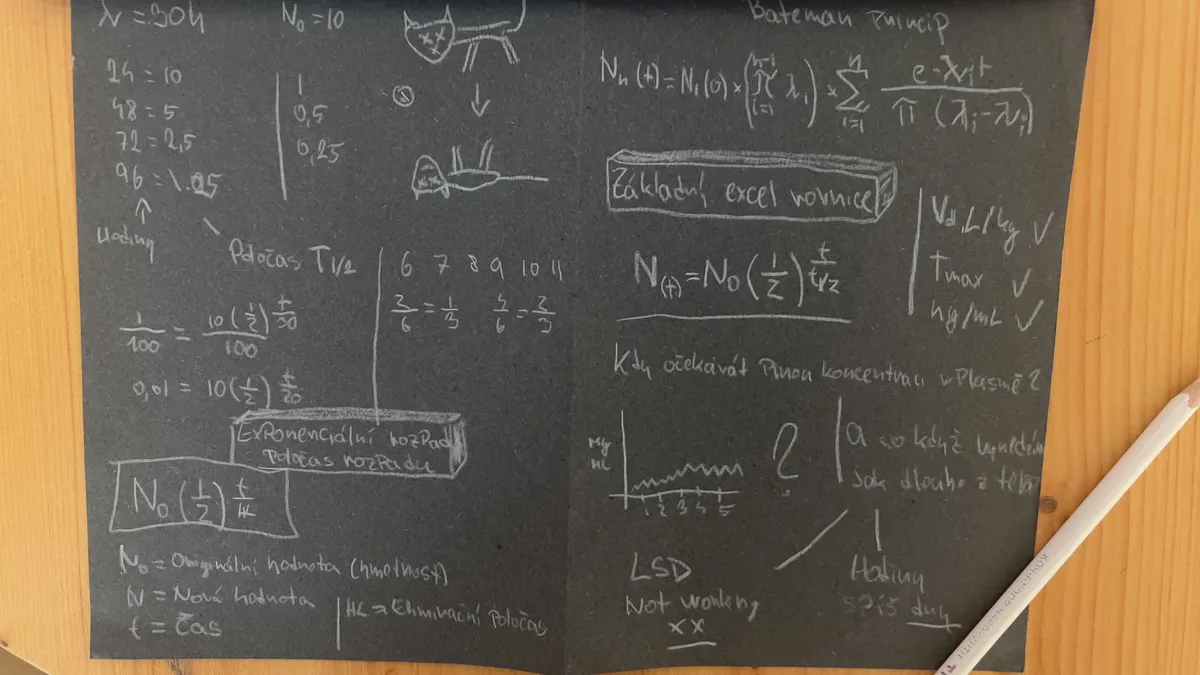 Revising logarithms (read: learning them all over again).
This was one of the hardest parts, as it required logical thinking and a simple exponential decay just wasn't enough. (I won't lie, the internet helped a lot). So the graph wouldn't look like the drug in the blood was shooting straight up like crypto in 2021, the Bateman principle had to be used - a curve that accounts for both the absorption rate (Ka) and the elimination rate (Ke).
3. Finding the therapeutic window and the S-DCT phenomenon
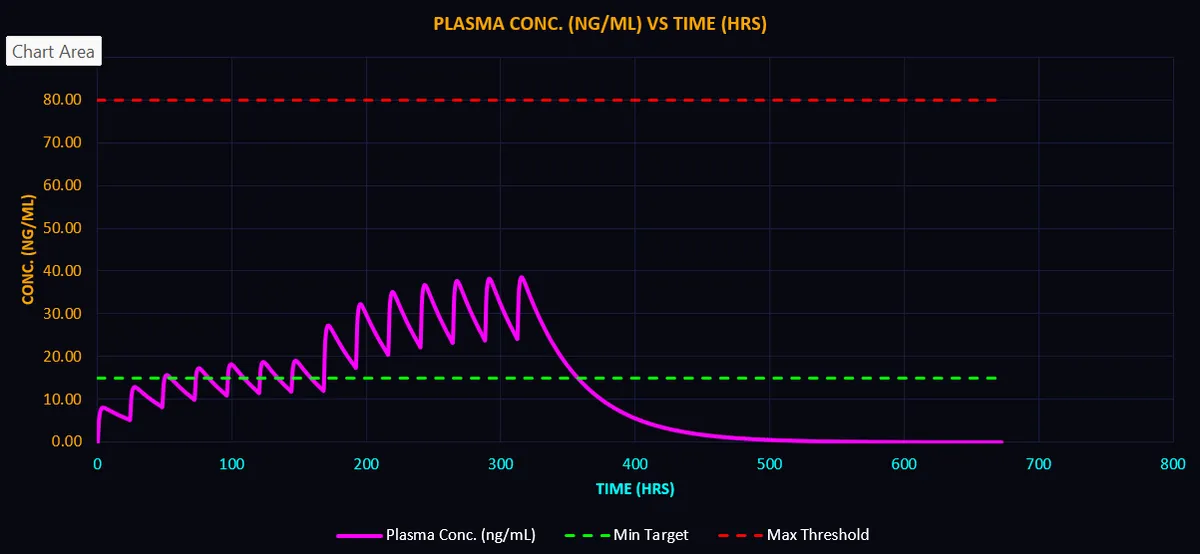
Measuring just "mg in the body" is misleading. To know if the treatment is working, we care about the blood plasma concentration (ng/mL). And that requires knowing the person's weight and volume of distribution (). The safe and functional therapeutic window for Lexapro is roughly 15 to 80 ng/mL.
Another nuance - when Escitalopram breaks down in the liver, it doesn't just disappear. It turns into a metabolite called S-desmethylcitalopram (S-DCT). This is still active in the brain, just much more weakly, but it has a crazy half-life of 50 hours. So in the final dataset, we are actually tracking two curves, not one.
4. Excel and dynamic dosing
I don't know advanced arrays in Excel, so I did it the old-school way and broke everything down (don't judge me). Because psychiatrists usually won't blast you with a full dose on day one, the model accounts for the fact that you might take 5mg for the first 7 days and 10mg the following week. The columns thus add up the overlaps of old, still-circulating remnants of the dose with the new ones.
Excel equation for basic decay:
5. Functional dataset
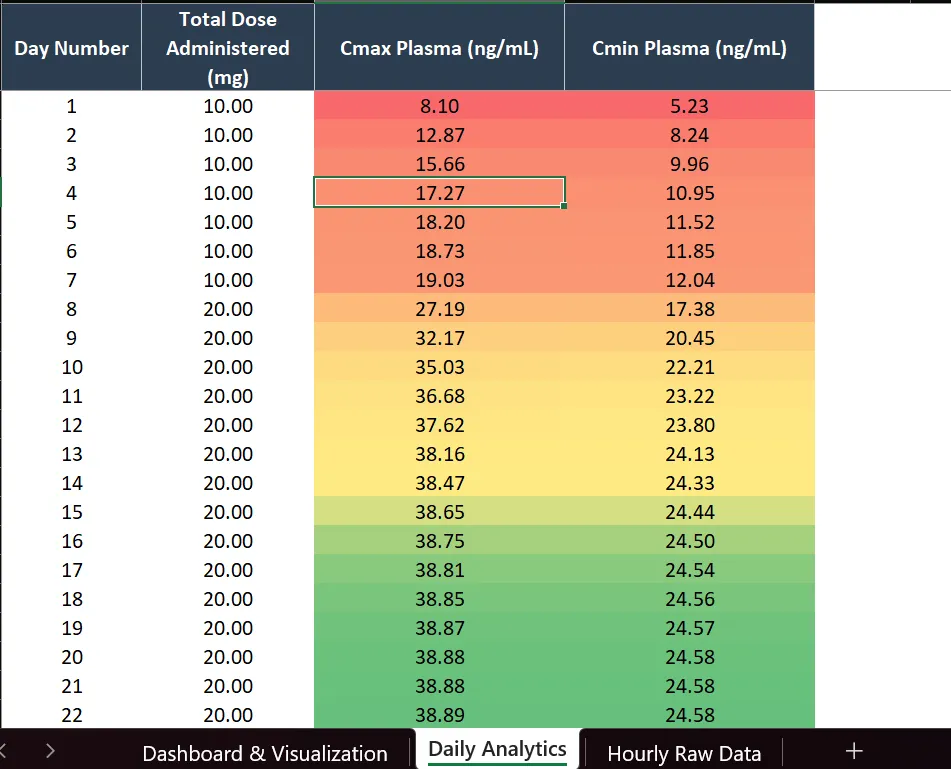
Amount during the first twenty-eight days and the ramp-up to steady-state
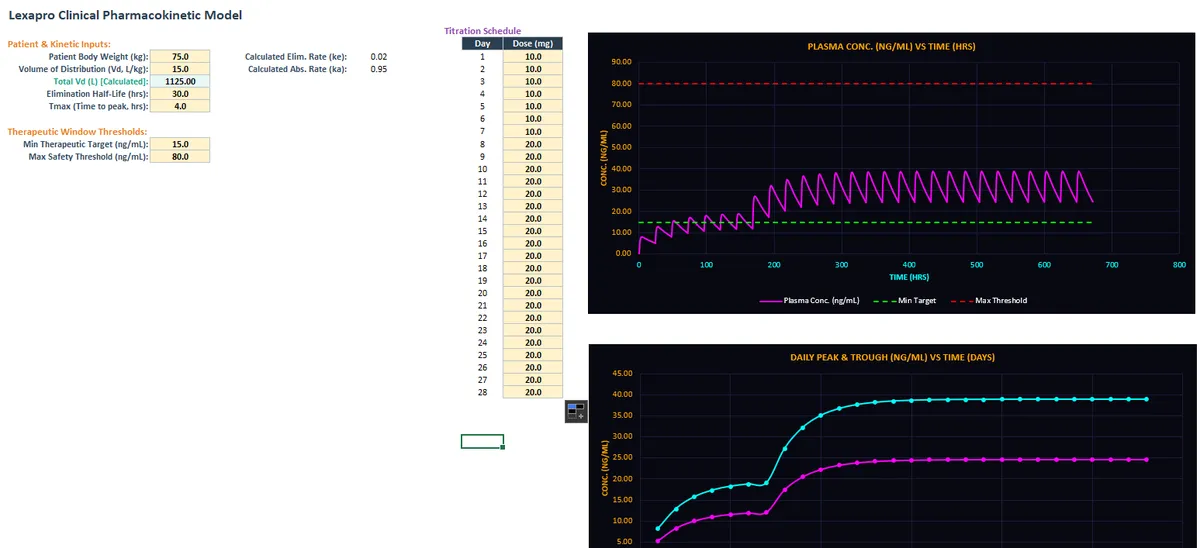
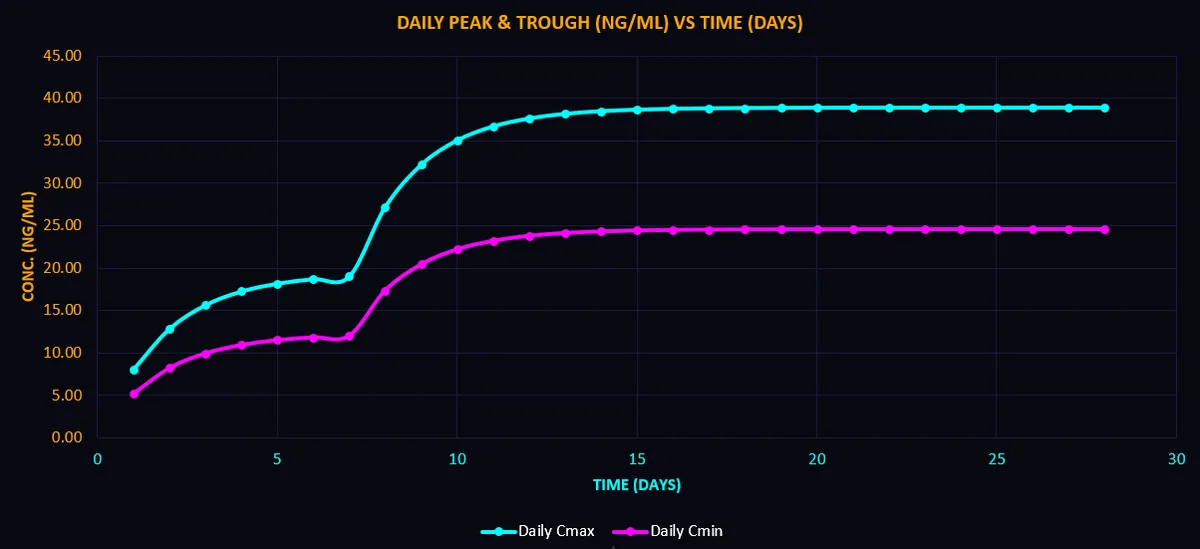
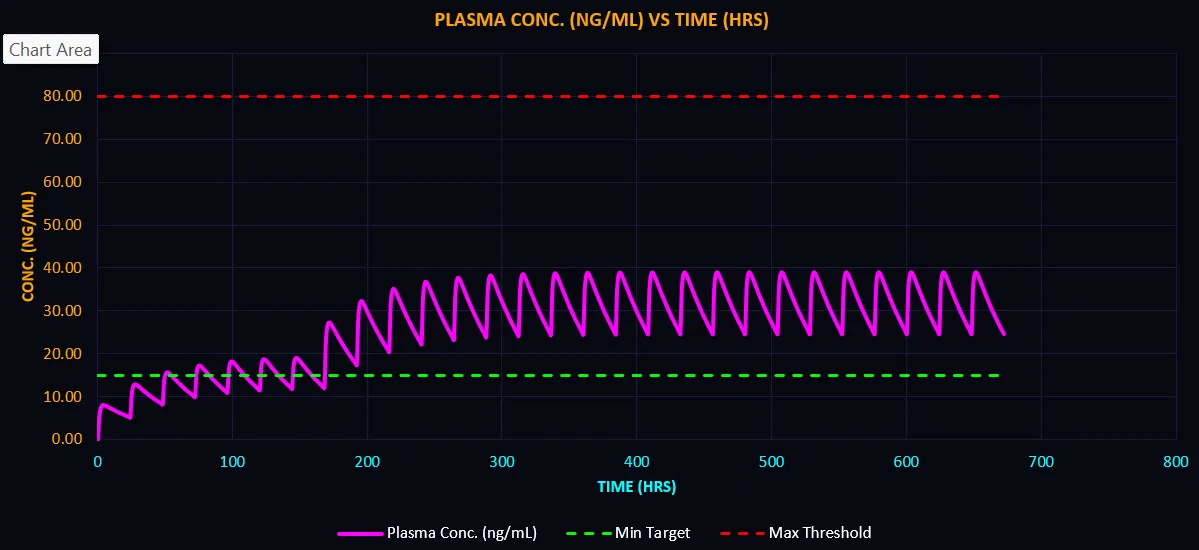
Half-life concentration by days (including absorption and elimination)
Conclusion
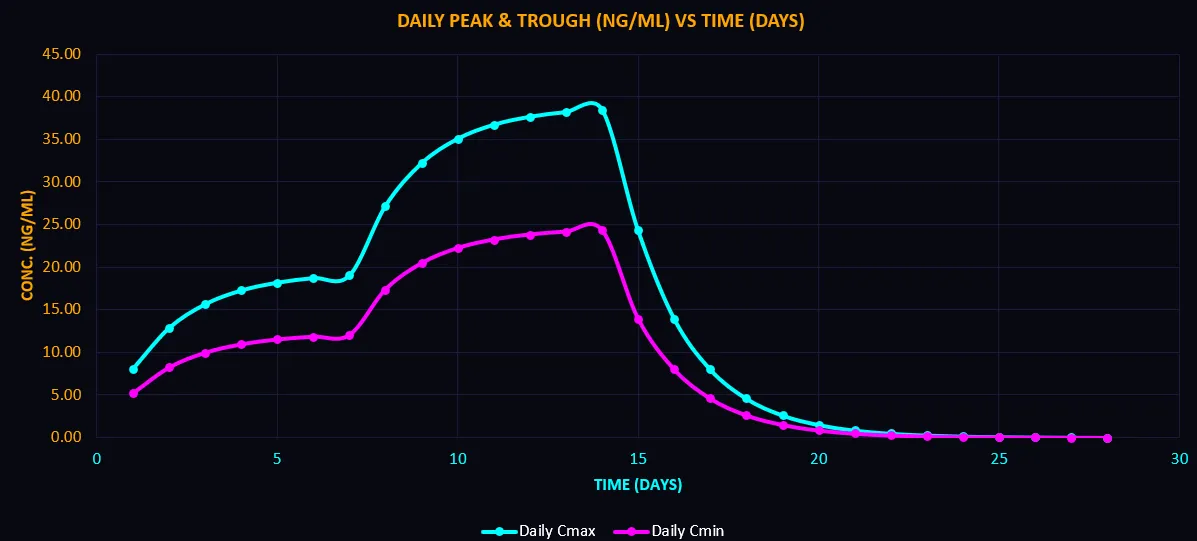
You can beautifully see in the graph what happens. The first five to six days are an absolute rollercoaster from a chemistry perspective. Serotonin levels in the synapses rise, the body fights it, and the brain has to process this brutal change. It takes roughly just under a week of regular dosing (or after every dose increase) for the concentration to reach a so-called steady-state. It stops fluctuating wildly and settles at a functional level. That is exactly the moment when the most severe side effects usually start to fade away.
[Bonus] What happens after abrupt discontinuation
If you ever want to stop - maybe for the therapeutic effects of LSD, Psilocybin, or you just run out of meds - you are in for a hell of a ride for the first seven days. But you also know how long to wait so you don't get serotonin syndrome.
[Bonus 2] Interactive table
If you want to test out different meds, or perhaps adjust the amounts, I've prepared this simple interactive table.
Escitalopram Pharmacokinetics
1-Compartment Bateman Clinical Simulation Engine
Patient & Kinetics
Therapeutic Window
28-Day Titration
Daily dose (mg). Use '0' to skip.
Daily Analytics
Hourly Raw Data
!READ!
I wash my hands of all responsibility for the provided data.
First, there are many types of antidepressants. I am mentioning strictly escitalopram here, which belongs to the class of selective serotonin reuptake inhibitors (SSRIs). And second, the data and graphs for them are created as an analytical model for informational purposes, not as a medical diagnosis.
It completely ignores very important variables:
- brain morphology and its receptors
- your genetic profile of liver enzymes (especially the cytochrome P450 family)
- body fat (affecting the volume of distribution of drugs)
- age and gender
- blood circulation (and potential interactions with other drugs)
- diet (and potentially caffeine/nicotine)
- liver and kidney function
- and much more
References
https://en.wikipedia.org/wiki/Escitalopram
https://en.wikipedia.org/wiki/Half-life
https://en.wikipedia.org/wiki/Exponential_decay
https://www.mayoclinic.org/diseases-conditions/depression/in-depth/ssris/art-20044825
https://www.drugs.com/article/drug-half-life.html
TL;DR: Starting antidepressants (specifically SSRIs) is a shock to the brain. Mathematically, it takes roughly a week before the drug level in the blood and brain stabilizes (the steady-state) due to the half-life and metabolic rate. Until then, you experience a chemical rollercoaster, which explains most of the temporary, albeit unpleasant, side effects that people on Reddit love to write horror stories about. Hang in there.